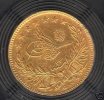
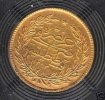
Du hast damit sicherlich recht, ich gebe mich geschlagen. Ist ja auch nicht mein Sammelgebiet.
1. Mohammed wurde nicht 622 geboren, sondern 622 ist er aus Mecca geflohen (auf einer Kuh), warum soll es auch einfach sein.
2. Diese erwähnte 500 Kurus Münze ist im KM auch nicht richtig erwähnt. Das Bild zeigt eine 500 Kurus mit AH 1293 und Jr. 2 (die es bis Jr. 6 gibt) und einen anderen Typ Jr. 11 bis 24.
Jetzt weiß ich auch nicht mehr weiter.
Auszug aus “World Coins 1901 - Present” by Krause – Mishler 32nd Edition
DATING
Coin dating is the final basic attribution consideration. Here, the problem can be more difficult because the reading of a coin date is subject not only to the vagaries of numeric styling, but to calendar variations caused by the observance of various religious eras or regal periods from country to country, or even within a country. Here again with the exception of the sphere from North Africa through the Orient, it will be found that most countries rely on Western date numerals and Christian (AD) era reckoning, although in a few instances, coin dating has been tied to the year of a reign or government. The Vatican, for example dates its coinage according to the year of reign of the current pope, in addition to the Christian-era date.
Countries in the Arabic sphere generally date their coins to the Muslim era (AH), which commenced on July 16, 622 AD (Julian calendar), when the prophet Mohammed fled from Mecca to Medina.
As their calendar is reckoned by the lunar year of 354 days, which is about three percent (precisely 2.98%) shorter than the Christian year, a formula is required to convert AH dating to its Western equivalent. To convert an AH date to the approximate AD date, subtract three per¬cent of the AH date (round to the closest whole number) from the AH date and add 622. A chart converting all AH years from 1010 (July 2, 1601) to 1421 (May 25, 2028) is presented as the Heijra Chart on page 35.
The Muslim calendar is not always based on the lunar year (AH), however, causing some confusion, particularly in Afghanistan and Iran, where a calendar based on the solar year (SH) was introduced around 1920. These dates can be converted to AD by simply adding 621. In 1976 the government of Iran implemented a new solar calendar based on the foundation of the Iranian monarchy in 559 BC. The first year observed on the new calendar was 2535 (MS), which commenced March 20, 1976. A reversion to the traditional SH dating Standard occurred a few years later.
Several different eras of reckoning, including Christian and Muslim (AH), have been used to date coins of the Indian subcontinent. The two basic Systems are the Vikrama Samvat (VS), which dates from Oct. 18, 58 BC, and the Saka era, the origin of which is reckoned from March 3, 78 AD. Dating according to both eras appears on various coins of the area.
Coins of Thailand (Siam) are found dated by three different eras. The most predominant is the Buddhist era (BE), which originated in 543 BC. Next is the Bangkok or Ratanakosindsok (RS) era, dating from 1781 AD; followed by the Chula-Sakarat (CS) era, dating from 638 AD. The latter era originated in Burma and is used on that country's coins.
Other calendars include that of the Ethiopian era (EE), which commenced seven years, eight months after AD dating; and that of the Jewish people, which commenced on Oct. 7, 3761 BC. Korea Claims a legendary dating from 2333 BC, which is acknowledged in some of its coin dating. Some coin issues of the Indonesien area carry dates determined by the Javanese Aji Saka era (AS), a calendar of 354 days (100 Javanese years equal 97 Christian or Gregorian calendar years), which can be matched to AD dating by comparing it to AH dating.
The following table indicates the year dating for the various eras, which correspond to 2002 in Christian calendar reckoning, but it must be remembered that there are overlaps between the eras in some instances.
Christian era (AD) -2003 is compared to
Muslim era (AH) -AH 1424
Solar year (SH) -SH1381
Monarchie Solar era (MS) -MS2562
Vikrama Samvat (VS) -VS2060
Saka era (SE) -SE1925
Buddhist era (BE) -BE2546
Bangkok era (RS) -RS222
Chula-Sakarat era (CS) -CS1365
Ethiopian era (EE) -EE1997
Korean era -4336
Javanese Aji Saka era (AS) -AS1936
Fasliera(FE) -FE1413
Jewish era (JE) -JE5763
Hier nochmal die arabischen Zahlen, wobei die türkische 4 eher wie ein Sigma aussieht.
Anhang anzeigen 15557 Gruß, Raute<!-- / message -->