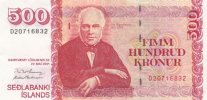
"Serie - Neue Banknoten"

Island out now

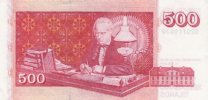
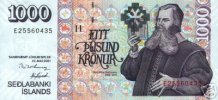
So , nun hat Island seit anfang der woche seine neuen Scheine ausgegeben:

es handelt sich um den 500er und den 1000er.
Es haben leichte Modifikationen der Banknoten stattgefunden.

Der weise Rand musste einem durchgehend farbigen Druck Platz machen, auf dem 100er kam zusätzlich eine Silberfolie dazu.

Das DAtum hat sich mit 2001 leider nicht geändert, die Unterschriften sind von den 2001er Versionen erhalten geblieben.

Anbei die Bilder
 

Anhänge

  • IS_500_2005_f.jpg
    IS_500_2005_f.jpg
    66,9 KB · Aufrufe: 303
  • IS_500_2005_b.jpg
    IS_500_2005_b.jpg
    59,2 KB · Aufrufe: 309
  • IS_1000_2005.JPG
    IS_1000_2005.JPG
    26 KB · Aufrufe: 316
Zypern

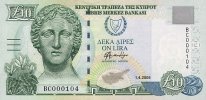
Seit dem 01. april gibt es auch in Zypern eine neue Note mit 2005er Datum.

Design etc. alles gleich geblieben.

Anbei das Bild
 

Anhänge

  • CYP_10P_2005.jpg
    CYP_10P_2005.jpg
    73 KB · Aufrufe: 328
mika-r schrieb:
Anbei der Bericht.

PS: Bessere Scans folgen.

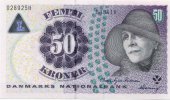
50 KRONE BANKNOTE

On 25 August 2005 Danmark's Nationalbank introduces a new, a more secure 50-krone banknote with a hologram and fluorescent colours. The motifs remain unchanged. The new 50-krone banknote completes the upgrading of the Danish banknote series. For additional information see Denmark National Bank Press Release 24 August 2005

Format 125 mm x 72 mm. Issued on 25. August 2005.

Hologram and fluorescent colours:

The metallic hologram on the face of the banknote alternately shows the figure 50, the Roman numeral L and a flower. Fluorescent colours, which are visible under ultraviolet light, are used on both sides of the banknote. On the face, a centaur becomes visible under ultraviolet light, and on the reverse the green colour shines, particularly in the ring on the right-hand side of the banknote.


The portrait of Karen Blixen: The face of the banknote bears a portrait of the writer Karen Blixen (17 April 1885 – 7 September 1962). She is acclaimed for e.g. Seven Gothic Tales (1935) and her memoirs Out of Africa (1937). The face of the banknote is also decorated with flowers, of which Karen Blixen was very fond.

The centaur on the reverse: The motif on the reverse of the 50-krone banknote is inspired by a stone relief from Landet Church on the island of Tåsinge.


The 50-krone banknote bears the word "femti", not "halvtreds" which is the usual Danish word for "fifty". Femti is a numeral used on cheques and giro payment orders. Danmarks Nationalbank first used it on the 50-krone banknote issued in 1957, and the present banknote is thus the third to bear this word


Quote: Extract from Denmark National Bank


Anbei ein besseres Bild
 

Anhänge

  • DK_50_2005.jpg
    DK_50_2005.jpg
    101,2 KB · Aufrufe: 378
Korea neuer 5000er vorgestellt

Hier der Bericht:

New 5,000-Won Banknote Unveiled


By Na Jeong-ju
Staff Reporter


The Bank of Korea (BOK) Wednesday unveiled the design for the new 5,000-won banknote and its anti-forgery features.

Printing will begin on Monday at the newly-built minting lines of the Korea Minting and Security Printing Corporation in Kyongsan, North Kyongsang Province.

The BOK said it will issue the new bills early next year. The specimens of the new 10,000-won and 1,000-won bills will be unveiled in the first half of next year, the central bank said.

The bank used hologram technology in the design of the 5,000-won banknote. Depending on the angle it is seen in, the hologram shows the images of the Korean map and elements of the yin and yang symbol, the taegeuk in Korean. It also used special ink on the number 5,000 in bottom right-hand corner of the bill’s reverse side, appearing different colors depending on the angle in which it is seen.

On the reverse side, the bank wrote the letters ``5,000 won’’ and ``Bank of Korea,’’ discernable only by a microscope. The note has an unexposed fluorescent silver strip on both sides. The color of the 5,000-won note can also appear reddish-yellow from its usual yellowish brown.

In addition, the bank changed the shape of the BOK governor’s seal at the center of all banknotes from a circular to a rectangular shape for the first time since banknotes were introduced in 1950.

The red, circular-shaped seal has been considered one of the remaining vestiges of Japanese imperialism. After its establishment in June 1950, the BOK began issuing bills that were modeled on Japanese bills. The color of the seal was also changed from red into reddish-yellow.

The reported number of bogus 5,000-won banknotes shot up 1,301.5 percent to 4,639 during the first half of the year, compared to 331 over the same period in 2004. The BOK has said this was due to insufficient anti-forgery features on the 5,000-won note.


Quelle: http://times.hankooki.com/lpage/200511/kt2005110217285410220.htm
 

Anhänge

  • kt2200511021740230ch.jpg
    kt2200511021740230ch.jpg
    164,7 KB · Aufrufe: 379
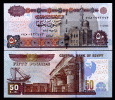
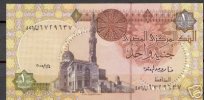
Agypten 2005

out now:

1 und 50 Pfund Ägypten mit Emmissionsdatum 2005

Anbei die bilder
 

Anhänge

  • EGY_50P_2005.gif
    EGY_50P_2005.gif
    442,3 KB · Aufrufe: 361
  • EGY_1_2005.JPG
    EGY_1_2005.JPG
    24,8 KB · Aufrufe: 293
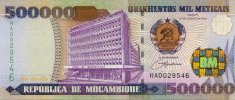
Währungsreform 2006: nach ZIM und AZB nun auch Mosambik!!!

Anbei der Originalartikel aus: http://allafrica.com/stories/200511160456.html


Assembly Passes Bill to Simplify Currency

Agencia de Informacao de Mocambique (Maputo)

November 16, 2005


The Mozambican parliament, the Assembly of the Republic, on Wednesday passed the first reading of a government bill designed to make the country's currency, the metical, more manageable, by lopping off the last three digits.

The bill establishes a rate of conversion of one to a thousand. Thus the current 1,000 metical coin will be worth one metical in what the government refers to as the "new family" of the currency. The largest current banknote, for 500,000 meticais, will be worth 500 meticais in the "new family". The metical was introduced in 1980 to replace the colonial currency, the escudo, and started off at parity with the escudo, and an exchange rate of about 40 to the US dollar. In those days the smallest coin was for 50 centavos (half a metical), and the largest note had the face value of 1,000 meticais.

But huge devaluations in the late 1980s and early 1990s, pushed the exchange rate up until it eventually reached the current 29,000 meticais to the dollar. Small items cost thousands of meticais, and even the statutory minimum wage is now over a million meticais.

Introducing the bill, Finance Minister Manuel Chang argued in favour of knocking off the last three zeroes, on grounds of efficiency and convenience. Book-keeping is more difficult, and more prone to errors, when sums have to be written in millions or billions. Companies, he said, found that the columns in their books were just not wide enough to accommodate all the zeroes. Certain computer programmes could not be used for Mozambican accounts because there were too many digits.

Chang said that, with inflation fairly low (it is expected to be well under ten per cent this year), and with the macro- economic stability of recent years, the time had come to adjust the currency.

The bill gives the Bank of Mozambique the power to design the new notes and coins, which should enter circulation in January. For a transitional period the old notes and the new notes will both be used, and shops and other businesses must express their prices in both old and "new" meticais.

"Reducing the number of digits will not affect purchasing power", Chang insisted. All that was involved was a mathematical operation of dividing by a thousand. As the old notes come into banks, so they will be withdrawn from circulation. This, Chang said, had no implications either for the state budget or for the budget of the Bank of Mozambique.

Every year the Bank of Mozambique withdraws old notes and issues new ones, paid for out of its own budget. The only difference this time is that the notes will bear different designs.

In fact, the Minister argued, issuing costs could be cut with the new notes, which will be of better quality and will last longer.

Chang stressed that the name of the currency remains the same - the metical. Knocking off the zeroes was, in his view, just an accounting operation, which did not mean that Mozambique was switching to a new currency. This was the third metical "family" - the second, Chang reminded deputies, happened after the Constitution of 1990 changed the name of the country from the "People's Republic of Mozambique" to the "Republic of Mozambique". The banknotes issued after this decision were different because they bore the country's new name.

But the opposition Renamo-Electoral Union coalition insisted that the government was changing the currency, and since the currency is established in the constitution, this was equivalent to a constitutional amendment - and thus it needed a two thirds majority in the Assembly.

"How is this not an alteration of the currency ?", asked Renamo deputy Jose Manteigas. "Implicitly you are saying there will be two currencies in circulation. Is this an attempt by the current government to distinguish itself from the former one ?" Luis Boavida demanded to see the design of the new notes and coins. "We're being asked to approve something to which we have not been given access", he claimed.

Chang retorted that the only thing the government was taking to the Assembly was the conversion rate of 1,000 to one.

Everything else (including the design of notes and coins) was in the hands of the central bank.

"The name of the currency is the same", he said. "We don't want to change the currency. We just want to change the number of zeroes".

Renamo also complained that banknotes carry the national emblem, and the emblem is under discussion in the Assembly. Jose Palaco suggested this was a way for the Frelimo majority to sabotage discussion of the emblem.

Others argued that costs would be incurred - because new notes would be printed with the existing emblem, then another set of notes would be required when the emblem was changed.

But in fact, there is no legal requirement for the Bank of Mozambique to put the emblem of the Republic on the notes at all.

When it came to a vote, Renamo insisted on the "prior question" of a two-thirds majority. Was this a substantive change to the currency which required such a majority ?
Relevant Links
Southern Africa
Currencies
Legal and Judicial Affairs
Mozambique
Sustainable Development
Economy, Business and Finance

The majority Frelimo Party did not think so, and so Renamo lost that vote by 155 to 79.

On the first reading of the bill itself, the Renamo deputies all abstained, and so it was passed by 155 votes to none, with 79 abstentions.
 

Anhänge

  • MOC_500K_2003.jpeg
    MOC_500K_2003.jpeg
    122,7 KB · Aufrufe: 317
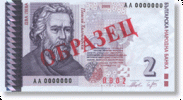
Bulgarien neue Banknote 2 Lewa 2005

Hallo zusammen,

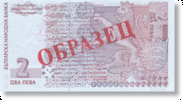
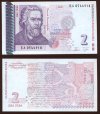
anbei möchte ich die neue Banknote der Bulgarischen Nationalbank vorstellen, und zwar die 2 Lewa Note 2005, die erst vor kurzem erschienen ist.

Der Wert entspricht ca. 1 Euro, da der Lew an die DM und seit 2002 an den Euro gebunden ist, wobei der Kurs 1 Euro =1,95583 Lewa wie bei der DM ist.

Hier weitere Infos von der Seite der Bulgarischen Nationalbank:

2 levs
2005

An engraving of Pagisios of Chiliandar is the major item on the obverse side. The background depicts the Zografou Monastery on Mount Athos, the Monastery Seal, and the interior of Pagisios' monastic cell.
Pagisios of Chiliandar (1722 - 1773), the man who kindled the spark of the Bulgarian National Revival, served in Holy Orders at the monastery of Chiliandar on Mount Athos. He authored the "Historiae Sclavo-Bulgaricus": the first work of modern Bulgarian letters and harbinger of Bulgarians' spiritual emancipation and national reawakening.

The reverse side shows a facsimile of the Zografou draft of the of the "Historiae Sclavo-Bulgaricus" with a list of Bulgarian rulers. This is overprinted with impressions of Tsar Kalogiannis Ring Seal and three seals with the images of Bulgarian Sovereigns Mihail Shishman, Svetoslav Terter and Tsar Ivan Asen II. The right side shows Hristofor Zhefarovich's lion rampant with the names of Bulgarian rulers from the First and Second Empires overprinted in microscopic lettering, Bottom right appears Bulgaria's Coat of Arms with three lions couchant, as published in the Gruenberg Heraldic Compendium of 1483.
Background colour - violet.
Paper - 100% cotton, in doublesided blue tones.
Dimensions - 116 x 64 mm.

Security Features
Anti-copy Stripe - a hologram stripe consisting of rhomboid elements which change their colour when seen from different angles.
Security Thread - a thread incorporated in the banknote paper with initials BNB appearing as a negative microprint.
Watermark - a half-tone silhouette of a rampant lion.
Fluorescence - elements of the pattern, serial numbers and fibres in the paper fluoresce under UV light.

Transparent register element - when the banknote is held against the light the digit "2" is seen in a square checkered field.

Microprint on the obverse - to the left of the portrait: the text PAGISIOS OF CHILIANDAR;

text 2 LEVS printed within the boundaries of the denomination digit "2"; vertical lines starting from the digit "2".

Microprint on the reverse - The image of the lion features the names of Bulgarian tsars IVAN ALEXANDER MIHAIL III SHISHMAN...

The obverse of the banknote features the embossed portrait, the texts BULGARIAN NATIONAL BANK, TWO LEVS), the vignette, and the digit of the denomination "2" on the anti-copy stripe.

Designation for blind people - two embossed rectangles.

Quellen : BNB, 2005
mika-r hat diese Bilder (verkleinerte Versionen) angehängt:
 

Anhänge

  • 0.1E8.gif
    0.1E8.gif
    29,1 KB · Aufrufe: 423
  • 0.7B82.gif
    0.7B82.gif
    35,2 KB · Aufrufe: 327
Zuletzt bearbeitet:
Bulgarien neue Banknote 2 Lewa 2005

Hier ist nun ein besserer scan der Banknote.

Deutlich zu erkennen, die neue Seriennummer, die Unterschriften und die Jahreszahl 2005.

Quelle: aus Ebay, 2005

mika-r hat dieses Bild (verkleinerte Version) angehängt:
 

Anhänge

  • 2lv2005.jpg
    2lv2005.jpg
    78 KB · Aufrufe: 369
Zuletzt bearbeitet:
Serbien neuer 50er (2005) und 100er (2004)

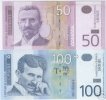
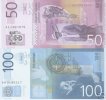
Anbei die Bilder der beiden neuen Banknoten aus SErbien:

50 Dinar (2005) und
100 Dinar (2004)
 

Anhänge

  • 16_1.JPG
    16_1.JPG
    28,2 KB · Aufrufe: 306
  • 06_1.JPG
    06_1.JPG
    26,8 KB · Aufrufe: 308
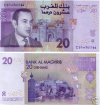
Marokko

So, nun hat Marokko auch den letzten Schein der neuen Serie eingeführt und damit die 2002er Serie mit Ihrem neuen König komplettiert.

Der neue 20er ist lila farben.

Anbei das Bild
 

Anhänge

  • f3_1_b.JPG
    f3_1_b.JPG
    32 KB · Aufrufe: 316
Zurück
Oben