App installieren
So wird die App in iOS installiert
Folge dem Video um zu sehen, wie unsere Website als Web-App auf dem Startbildschirm installiert werden kann.
Anmerkung: Diese Funktion ist in einigen Browsern möglicherweise nicht verfügbar.
Du verwendest einen veralteten Browser. Es ist möglich, dass diese oder andere Websites nicht korrekt angezeigt werden.
Du solltest ein Upgrade durchführen oder einen alternativen Browser verwenden.
Du solltest ein Upgrade durchführen oder einen alternativen Browser verwenden.
"Serie - Neue Banknoten"
- Ersteller mika-r
- Erstellt am


- Registriert
- 07.01.2004
- Beiträge
- 3.029
- Reaktionspunkte
- 2
Thailand neuer 1000er mit Holostrip
Hier der Bericht:
New Thailand Bt1,000 note hard to copy – BOT
The Bank of Thailand is to issue a new Bt1,000 banknote with a silver foil stripe in November. The note will be difficult to copy and is being introduced to combat forgery.
The managing director of the BOT’s note printing works, Nopporn Pramojaney, said yesterday that of all Thailand’s banknotes, the Bt1,000 note was most often forged. But this wasn’t always the case. There was a time when Bt100 and Bt500 banknotes were more popular among counterfeiters.
However, after the the central bank issued Bt100 and Bt500 banknotes with the added security of a silver foil stripe, forgery of those notes subsided.
"There have been some attempts to imitate the new Bt500 banknote," Nopporn said, "but they don’t look real".
Currently, there was reckoned to be only one fake Bt500 banknote for every 10 million banknotes in circulation. By comparison, in the US and euro zone, there were 60-70 fake banknotes for every 1 million notes in circulation.
Nopporn said that normally, if fake banknotes represented more than 5 per 1 million, the central bank would be obliged to issue new banknotes to replace the old ones.
The new Bt1,000 banknote will be similar to the current Bt100 and Bt500 banknotes, but its colour will remain the same. There will be a silver foil stripe stamped with His Majesty the King’s royal emblem and the number “1,000” in both Thai and Arabic numerals. The will be small "1,000" in Arabic numerals forming a background on the silver stripe. These will produce a reflecting effect when exposed to light.
The paper of the new banknote will also include a watermark portrait of His Majesty the King in a transparent area. The note will have a metal fibre embedded in the paper imprinted with "1000 BAHT", as well as Bt1,000 in Thai.
Nopporn said the new banknote would be printed using the latest technology, making it very difficult to duplicate.
The cost of producing it would be about Bt2 per note, double the cost of the old banknote.
At the end of December last year, 517.5 million Bt1,000 banknotes, 690.4 million Bt100 banknotes and 867.5 million Bt20 banknotes were in circulation.
Although the BOT is promoting electronic payment systems, Thai consumers are still fond of using cash, partly because it cannot be traced.
"Other payment systems have hidden costs," Nopporn said. "For example, payment via credit cards costs more than payment by cash."
Thai people use cash for as much as 70 per cent of the value of total payments, whereas cash to GDP is accounted at around 9 per cent.
Quelle: Anoma Srisukkasem, The Nation, Published on July 06, 2005.
mika-r schrieb:Erst jetzt wurde bekannt, dass eine Banknote zu 500 France bereits im Jahr 1995 gedruckt, bisher aber noch nicht ausgegeben wurde.
Der Schein ist somit seit kurzem erst - mit diesem Datum - im Umlauf.
Ausser dem Kommentar ("Burundi 500 Francs 5.2.95. This 1995 note was not issued until now. I'm not sure of history, why it is just now released/discovered.") war leider nicht viel zu erfahren.
Hier aber das Bild:
Burundi 1995 Ndadaye Note Not Issued
In June 1993, Melchior Ndadaye (March 28, 1953 - October 21, 1993), a member of the Hutu ethnic group, was elected President of Burundi in Burundi's first democratic elections. In less then four months he was kidnapped and killed as part of a coup d'etat by Tutsi military members. His killing was the event that triggered the beginning of the Burundi War.
Almost two years following the death of Ndadaye the Central Bank of Burundi sought to honor Ndadaye by placing his portrait on a new 500 Franc banknote, dated 05-02-1995. This banknote was never issued however.
:heul:
- Registriert
- 07.01.2004
- Beiträge
- 3.029
- Reaktionspunkte
- 2
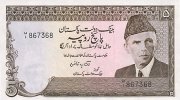
Pakistan: 5er wird ungültig
Hier der Bericht:
Legal value of five rupee notes ends
KARACHI: The five rupees note, which was in use for buying commodities for the last 56 years, has now become a part of history from today.
The State Bank has announced that the legal status of five rupee notes would end from 1st July and coins would be used in its place.
These notes were issued in London for the first time in 1948 and were printed there. The five-rupee note was printed in Pakistan for the first time in 1951.
Quelle: http://www.geo.tv/main_files/business.aspx?id=81249
Anhänge


jeggy
********
- Registriert
- 25.01.2004
- Beiträge
- 7.927
- Reaktionspunkte
- 354
Die nennt man Notaphilisten.Dr.Corsa schrieb:Hallo!
Ich weiß nicht so recht, wo ich da fragen bzw. nachgucken soll, also frage ich einfach hier. Und zwar würde ich gerne wissen, wie man die Leute nennt, die die Geldscheine sammeln? Kenn mich da absolut nicht aus.
Gruß
Michael
Gruss,
jeggy
- Registriert
- 07.01.2004
- Beiträge
- 3.029
- Reaktionspunkte
- 2
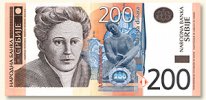
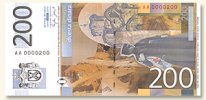
Serbien neue Banknote zu 200 Dinara 2005
Hallo Notaphilisten
Anbei ein neuer Schein aus Serbien.
Ich weiß das Bildle is net so toll ,ein besseres werde ich zur gegebenen Zeit nachreichen.
Das ist die neuestes note aus Serbien - mit "neuem" alten Wappen von 1907.
Damit hat die neue Serie jetzt 5 Werte - neben dem 100, 500, 1000 und 5000er.
Hallo Notaphilisten
Anbei ein neuer Schein aus Serbien.
Ich weiß das Bildle is net so toll ,ein besseres werde ich zur gegebenen Zeit nachreichen.
Das ist die neuestes note aus Serbien - mit "neuem" alten Wappen von 1907.
Damit hat die neue Serie jetzt 5 Werte - neben dem 100, 500, 1000 und 5000er.
Anhänge
- Registriert
- 07.01.2004
- Beiträge
- 3.029
- Reaktionspunkte
- 2
neuer $10 Schein USA ab Frühjahr 2006
Hier der Bericht:
Coming Next: A Newly Redesigned $10 Note
Safer, Smarter and More Secure $10 Note Expected To Enter Circulation in Early 2006
WASHINGTON - April 4, 2005 - Much like the redesigned $20 and $50 notes that have been issued over the last two years, the $10 denomination will be the next note slated for a make-over by the Treasury's Bureau of Engraving and Printing (BEP). The newly designed $10 note is scheduled to be issued by the Federal Reserve in early 2006.
Similar to the new $20 and $50 notes' designs, the updated $10 note will feature enhanced security features, subtle background colors and American symbols of freedom. The new design of the $10 note is scheduled to be unveiled in late 2005.
The BEP has begun working with cash-handling equipment manufacturers to prepare that industry for the note's new design. This advance information allows the makers of vending machines, ATMs and other machines that receive and dispense cash to make technical adjustments to their equipment before the note goes into circulation. As with previous currency redesigns, the BEP will provide manufacturers with test notes and specifications about six months in advance of the note's entry into circulation.
"The BEP is working hard to ensure that the transition of the newly redesigned $10 note is as smooth as that of the $20 and $50 notes," said Tom Ferguson, director of the BEP. "We have worked closely with the cash-handling equipment manufacturers throughout the new currency program so that they have the information they need to ensure their machines accept the new bills."
The $100 note is also slated to be redesigned, but a timetable for its introduction is not yet set. The government has no plans to redesign the $5 note at this time, and the $1 and $2 notes will not be redesigned.
Public Education
Because the improved security features are more effective if the public knows about them, the U.S. government has undertaken a broad, global public education program. This program ensures that people all over the world know the new currency is coming, and helps them recognize and use the security features. The outreach includes cash handlers, merchants, business and industry associations, and the media.
A variety of training materials - such as posters, training videos and brochures - is available for the $20 and $50 redesigns in 24 languages. These materials are available through our website at www.moneyfactory.com/newmoney. Training materials specific to the $10 redesign will be available after its new design is unveiled.
Since the BEP began taking orders in May 2003, more than 62 million pieces of training materials, such as brochures, posters, videos and CD-ROMs, have been ordered by businesses and other organizations to help them train their cash-handling employees about the redesigned notes' enhanced security features.
The New Color of Money
While consumers should not use color to check the authenticity of their currency (relying instead on user-friendly security features - see below), color does add complexity to the note, making counterfeiting more difficult. Different colors are being used for different denominations, which will help everyone - particularly those who are visually impaired - to tell denominations apart.
Security Features
The new $10 redesign will retain three important security features that were first introduced in the 1990s and are easy for consumers and merchants alike to check:
* Color-shifting ink: The numeral in the lower right corner on the face of the note, indicating its denomination, changes color from copper to green when the note is tilted.
* Watermark: A faint image, similar to the portrait, which is part of the paper itself and is visible from both sides when held up to the light.
* Security thread: Also visible from both sides when held up to the light, this vertical strip of plastic is embedded in the paper and spells out the denomination in tiny print.
Counterfeiting: Increasingly Digital
Counterfeiting has been kept at low levels through a combination of improvements in security features, aggressive law enforcement and education efforts to inform the public about how to check their currency.
However, since 1995, digitally produced counterfeit notes have increased from less than one percent of all counterfeits detected in the United States to about 54 percent in 2004. To stay ahead of counterfeiters as advances in technology make digital counterfeiting of currency easier and cheaper, the government expects to redesign the currency about every seven to ten years.
Quelle: http://www.moneyfactory.com/newmoney/main.cfm/media/releases04042005
da ist auch ein knopf für alle sprachen / hier das ganze in deutsch 

Internationale Informationskampagne
Verantwortung. Vertrauen. Wert. Dafür steht der amerikanische Dollar auf der ganzen Welt. Für Millionen von Menschen außerhalb der Vereinigten Staaten ist die amerikanische Währung eine vertrauenswürdige Grundlage für Ersparnisse. Viele Menschen im Ausland verlassen sich bei ihren täglichen Geldtransaktionen auf den amerikanischen Dollar.
Laut Schätzungen der amerikanischen Notenbank, Federal Reserve, befinden sich bis zu zwei Drittel der im Umlauf befindlichen amerikanischen Währung außerhalb der USA. Das sind nahezu 700 Mrd. US-Dollar, die weltweit im Umlauf sind. Deshalb ist es wichtig, dass alle angesprochen werden, die die amerikanische Währung verwenden – sowohl in den USA als auch im Ausland – und ihnen Informationen über Änderungen an der Währung mitgeteilt werden.
Im Oktober 2003 gaben die Vereinigten Staaten ein neues Design der 20-Dollar-Note mit verbesserten Sicherheitsmerkmalen und zarten Hintergrundfarben, nämlich Blau, Grün und pfirsichfarben, aus. Am. 28. September 2004 wurde eine neue 50-US-Dollar-Note ausgegeben. Die nächste Stückelung, die im Rahmen der Serie eingeführt wird, ist die 10-US-Dollar-Note im Jahr 2005. Auch für die 100-US-Dollar-Note soll es ein neues Design geben. Der Zeitpunkt dieser Einführung liegt jedoch noch nicht fest. Gegenwärtig beabsichtigt die Regierung kein Neudesign der 5-US-Dollar-Note. Auch die 1- und 2-US-Dollar-Noten bleiben unverändert. Die Einführung neuer Währungsdesigns ist Teil der fortdauernden Anstrengungen seitens der amerikanischen Regierung, die Wirtschaft und das hart verdiente Geld der Bürger zu schützen.
Sowohl die neuen Noten als auch die Noten mit den alten Designs gelten weiterhin als Zahlungsmittel zum vollen Nennwert. Die alten 50-Dollar-Noten müssen nicht gegen neue eingetauscht werden. Die Vereinigten Staaten werden ihre Währung weder zurücknehmen noch abwerten. Das Geld ist und bleibt gut.
Da die amerikanische Währung außerhalb der Vereinigten Staaten so weit verbreitet ist, soll sichergestellt werden, dass Geschäfte und Finanzinstitutionen, Devisenhäuser, Polizeibehörden, Banken und alle sonstigen Personenkreise, die mit Bargeld arbeiten, sowie letztendlich die allgemeine Öffentlichkeit auf der ganzen Welt über die neuen Währungsdesigns und Merkmale Bescheid wissen.
Die für den Noten- und Münzdruck zuständige Druckerei, Bureau of Engraving and Printing, hat Informationsunterlagen wie z. B. Poster in 23 verschiedenen Sprachen entwickelt. Diese Unterlagen stehen Finanzinstitutionen und Geschäften im angemessenen Umfang kostenlos zur Verfügung.
Sie können eine kritische Rolle dabei spielen, dass die Informationen zur Einführung der neuen US-Noten in Ihrer Region gut vermittelt werden. Bitte klicken Sie hier - Bestellung, wenn Sie Unterlagen bestellen möchten.
Bitte kontaktieren (Contact Us) Sie uns, wenn Sie Fragen oder Vorschläge zur Informationsverbreitung über die neuen Designs der US-Banknoten haben. Sie können auch gerne E-Mail-Mitteilungen zur neuen Währung und zu unserer Öffentlichkeitsarbeit abonnieren. Wenn Sie mehr über die neue Währung erfahren möchten, können Sie sich auch an die für Sie zuständige US-Botschaft oder an Ihr Finanzinstitut wenden.
Quelle: http://www.moneyfactory.com/newmoney/main.cfm/welcome/de


- Goldpreis
- 3.517,60 €/oz
113,11 €/g
- Silberpreis
- 43,34 €/oz
1,39 €/g
- Bitcoin
- 58583,00€
- Ethereum
- 1641,30€
Wichtige Links
Werbung:
- Goldmünzen
- Euro-Links
- Andorra
- Deutschland
- Belgien
- Bulgarien
- Estland
- Finnland
- Frankreich
- Griechenland
- Irland
- Italien
- Kroatien
- Lettland
- Litauen
- Luxemburg
- Malta
- Monaco
- Niederlande
- Österreich
- Portugal
- San Marino
- Slowakei
- Slowenien
- Spanien
- Vatikan
- Zypern enthaltene Affiliatelinks sind bezahlte Werbung von Ebay