


enthaltene Affiliatelinks sind bezahlte Werbung von Ebay
App installieren
So wird die App in iOS installiert
Folge dem Video um zu sehen, wie unsere Website als Web-App auf dem Startbildschirm installiert werden kann.
Anmerkung: Diese Funktion ist in einigen Browsern möglicherweise nicht verfügbar.
Du verwendest einen veralteten Browser. Es ist möglich, dass diese oder andere Websites nicht korrekt angezeigt werden.
Du solltest ein Upgrade durchführen oder einen alternativen Browser verwenden.
Du solltest ein Upgrade durchführen oder einen alternativen Browser verwenden.
"Serie - Neue Banknoten"
- Ersteller mika-r
- Erstellt am


- Registriert
- 07.01.2004
- Beiträge
- 3.029
- Reaktionspunkte
- 2
Mexico präsentiert den 1,000 Peso Schein
Es gibt noch keine bilder, aber hier schon mal der Artikel:
Mexico unveils new 1,000 peso bill
(11-04) 18:46 PST MEXICO CITY (AP) --
Mexico unveiled a new 1,000 peso bill Thursday, the largest denomination available in the currency.
The bill, equivalent to $87, will begin circulating on Nov. 15. About 50 million will be put into circulation. Central bank officials said they created the new note after noticing increased use of 200-peso and 500-peso bills.
"There's a growing appetite to pay with higher-denominated bills," said Manuel Galan, the Bank of Mexico's director of programming, adding that the new notes will improve "efficiency in doing commercial transactions."
The purple-and-green-hued bill will feature the likeness of Miguel Hidalgo y Costilla, who led Mexico's 1810 independence.
The amount of bills and coins in circulation on a daily basis is currently about 280 billion pesos ($24.5 billion.)
Quelle: http://www.sfgate.com/cgi-bin/article.cgi?f=/news/archive/2004/11/04/financial1654EST6300.DTL
- Registriert
- 07.01.2004
- Beiträge
- 3.029
- Reaktionspunkte
- 2
Pakistan: Ausgabe neuer 20er und 5000er s
Printing of Rs. 20 and 5,000 notes underway
LAHORE, November 06 (Online): The printing of new currency notes of 20 and 5,000 rupees denominations, recently approved by the federal cabinet, is currently under way and the State Bank of Pakistan will circulate the new notes at the start of next year.
An informed official said the Rs. 20 and Rs. 5,000 currency notes would be floated in the money market only after the SBP finished the printing of targeted currency stock.
He said the printing process was likely to be completed by January 1, 2005.
He said the Bank was currently not issuing new currency notes of five rupees denomination and they would become invalid from the next fiscal year.
He said the collection of Rs. 5 old notes by the banks across the country was in progress and the same were being forwarded to the SBP, afterwards.
The official said the issuance of notes of large denomination would enhance their life.
In this regard, he said, the State Bank has already introduced five rupees coin to replace the currency note of the same denomination.
Quelle: http://paktribune.com/news/index.php?id=82769&PHPSESSID=fe33a02204ae8eeeaef98ed50851132e
- Registriert
- 07.01.2004
- Beiträge
- 3.029
- Reaktionspunkte
- 2
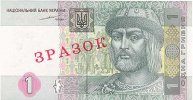
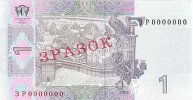
UKRAINE: Ausgabe der 1 Hryvna am 01. Dec. 2004
Am 1 Dezember wird die ukraine vorerast den letzten Schein der neuen Serie in diesem Jahr ausgeben:
Es handelt sich um den 1 Hryvna Schein.
Man hatte vermutet dieser sei endgültig von der Münze ersetzt worden, dem ist aber offensichtlich nicht so.
Hier die Daten:
The Banknote of 1 Hryvnia Denomination (2004)
On the face side of the new banknote, as well as on the previous banknotes of this denomination, there is a portrait of Volodymyr the Great, whereas on the reverse side instead of the remains of Chersonesus Tauricus there is a diorama of Volodymyr’s Burg in Kyiv.
Volodymyr the Great was a Grand Duke of Kyiv (980-1015). During his rule a rise of the Kyivan Rus as a solid community and a great power started off and all the Eastern Slavic lands were united under the dominion of Kyiv. In 988-989 Rus was Christianized on his initiative.
Volodymyr’s Burg in Kyiv (Detynets) – under such a denomination known is the citadel whose construction Volodymyr started as soon as he had taken possession of Kyiv.
In the end of the 10th century the wall system of Kyiv Detynets (citadel) contained several gates. One gate was for passage to Podil, another – in the direction of Pechersk, one more was for passage in the direction of St. Sophia Cathedral.
The main edifice of the 10th century Kyiv was the famous Tithe Church whose foundation was laid, according to the Tale of Bygone Years, in 989. In 996 the construction was completed and the church was consecrated.
Security elements for visual detection
The banknote is printed on the tinted paper of grey-green color which is the dominating color of the design of the banknote.
Banknote size (63x118) mm.
1. Watermark
A multi-tone portrait, formed by the internal structure of paper, has a fixed position on the banknote and becomes visible when the banknote is held up to the light. Repeats the portrait printed on the face of the note.
1a. Light Watermark Element
Imprint of the numerical indication of the denomination is visible when looking at the banknote against the light.
2. Security Thread
A fully embedded into the paper polymer thread with the following transparent direct and inversed images: “1 ГРН”, a trident and the underlined denomination “1”. The parts of the thread glowing in green-yellow and blue colors under the UV light.
3. See -Through Element
Printed elements on the face and on the back of the banknote which complement each other and form the letter “Y” when the note is held up to the light.
4. “Orloff” Printing
A special type of printing which forms a pattern with the ink of different colors ensuring an abrupt change of one color into another without intermittence and displacement of graphic elements of the pattern (lines, planes).
5. Microtext
Repeated inscriptions which can be read with magnifying glass.
6. Rainbow Printing
Special type of printing ensuring a smooth change of one color into another without intermittence and displacement of graphic elements of the pattern.
7. Serial Numbers
The serial numbers is printed in high printing:
1) with black inks having magnetic properties;
2) with red inks glowing under the UV light in yellow-red color.
8. Antiscanning Grid
Thin lines placed at different angles which form a moire pattern when copied or scanned.
9. Security Fibers
Chaotically embedded into the paper invisible security fibers glowing in red and green colors under the UV light.
Quelle: http://www.bank.gov.ua/Engl/Bank_coin/Banknoty/G1_04_discription_e.htm
Anhänge
- Registriert
- 07.01.2004
- Beiträge
- 3.029
- Reaktionspunkte
- 2
Island: updates der 500er und 1000er
Es gibt noch keine Bilder, aber hier der Bericht
Friday - 5.11.2004
Upgraded 1,000 and 500 króna banknotes
A new, upgraded 1,000 króna banknote will be issued on Monday, November 8.
The new banknote is essentially the same as its predecessor but incorporates a number of modifications for improved security. It is easier to recognise and more difficult to counterfeit. The version that it replaces will remain legal tender but gradually be withdrawn from circulation.
Modifications to the banknote’s appearance involve replacement of the white margin on the earlier notes with all-over lithographic printing, and the addition of two visible security features: a silver foil and a windowed cleartext thread. The new note incorporates a watermarked “cornerstone” which makes the corners stiffer and less likely to become folded. A fluorescent print has been added to the design, visible only in ultraviolet light. Further security features incorporated into the note can only be detected electronically.
The original 1,000 króna note was designed by Kristín Þorkelsdóttir, who also took part in its redesign, and Stephen A. Fairbairn. It is printed by De La Rue plc of England.
Just over 2.1 million of the earlier notes are presently in circulation. It was decided to add the new security features and bring the design into line with that of the 5,000 and 2,000 kr. notes as the time for reprinting approached. The first print run of the new version is four million notes. The average lifetime of a 1,000 kr. note has been 12 months. The older design will thus largely have been replaced within roughly one year.
A brochure describing the security features of the new 1,000 króna note will be sent to every household in Iceland. It will also describe the upgraded 500 kr. note due to be put into circulation in 2005.
This information can also be found on the Central Bank of Iceland website (www.sedlabanki.is) along with a variety of information about Icelandic banknotes and coin, past and present.
For further information, please contact the Governors of the Central Bank of Iceland or Tryggvi Pálsson, Director of the Financial Stability Department, tel. (+354) 569 9600.
No. 31/2004
November 5 2004
Quelle: http://www.sedlabanki.is/template2.asp?Redirect=False&pageid=135&nid=967
- Registriert
- 07.01.2004
- Beiträge
- 3.029
- Reaktionspunkte
- 2
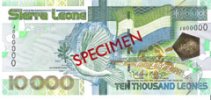
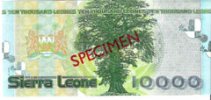
Sierra Leone: neuer 10.000er
Hier der Bericht, am besten auf der page selbst anschauen, da sind noch bilder und weitere Infos.
Bank of Sierra Leone Celebrates 40th Anniversary
By Marian Samu
WEDNESDAY, AUGUST 4: As part of its activities to commemorate forty years of existence, the Bank of Sierra Leone has today launched a new bank note of Le.10, 000 denomination, Le.500 coin and a special commemorative coin of Le100 denomination.
Before proceeding to launch the new bank note and coins, His Excellency President Alhaji Dr. Ahmad Tejan Kabbah, at a solemn ceremony at the Sam Bangura Building, unveiled the bust of the Late Samuel Lansana Bangura, former Governor of the Bank of Sierra Leone, after whom the new building hosting the bank's headquaters had been named.
Addressing bank officials, dignitaries and other guests at the unveiling ceremony, President Ahmad Tejan Kabbah said that they were joining the Bank of Sierra Leone in celebrating forty years of diligent national service in a very special and significant way, in honouring posthumously a distinguished and outstanding Sierra Leonean who was one of the architects of the institution known as the Bank of Sierra Leone.
The President described the Late Samuel Lansana Bangura as a nationalist, a patriot and selfless leader who served his country and people with unparalleled commitment, dedication and distinction. He said that Mr. Sam Bangura was a cheerful, humane and visionary leader who fought endlessly as the good shepherd for the welfare of those in his charge, and motivated and protected both the strong and the weak. "A true patriot with sterling leadership qualities", the President said of the late bank governor.
President Kabbah said that though Sam Bangura died 25 years ago, he left indelible footprints in the sands of time, and the building which houses the new Bank of Sierra Leone bears testimony to the description of the man.
The late Sam Bangura was born in Yele in the northern province of Sierra Leone. He attended the Bo Government Secondary School and later studied at the University of Hull in the United Kingdom. He had a distinguished career in the Civil Service prior to his appointment as Deputy Governor of the Bank of Sierra Leone in 1970. Mr. Bangura rose to become governor and served diligently in that role until December 1979, when he died in mysterious circumstances.
A former director of the Bank of Sierra Leone and now Managing Director of the National Development Bank, Mr. M.M. Turay, who served during the late Sam Bangura's tenure also paid tribute to the late bank governor.
At the launch of the new currency note and coins, the Governor of the Bank of Sierra Leone, Dr. James D.Rogers, said that the launching of the note and coins marked another momentous landmark in the history of the Bank. One of the main functions of the Bank, he said, is to issue currency notes and coins to meet the transaction needs of business and the general public, with a stable value and integrity that will promote confidence in the financial system and the economy.
The Governor said that the Bank's policy of issuing currency is consistent with the clean note policy, which maintains a constant level of clean notes in circulation by replacing banknotes demonetised and destroyed during the period.
Dr. Rogers explained that before embarking on the issuing of new currencies, the Bank of Sierra Leone Currency Management Programme over the years undertook studies on the volume of banknotes for each of the existing denominations, as well as the denominational structure of coins that will be required for issue into circulation, consistent with the targeted growth in real GDP. He said that the Bank in line with the programmed GDP growth rate of 6% has projected that Le.22 billion of new denomination currency will be introduced into the economy as against a total value of Le.30 billion that will be demonetised and destroyed as part of the Bank's Currency Management Programme and clean note policy in 2004.
He described the new Le.10, 000 banknote, which is the 13th in the family of currency notes to be launched and circulated since the establishment of the bank forty years ago in 1964, as one with more modern and sophisticated security features than that of any bank note series presently in circulation. Dr. Rogers said that the theme for the Le. 10,000 notes, "National Cohesion leading to Peace and Prosperity", was proposed by President Kabbah, and is inscribed on the reverse side of the note. The new ten-sided bi-colour Le.500 coin, which is the 11th in the family of coins so far issued continues to bear the portrait of the former Kissy King, Kai Londo.
The President graciously launched the new currencies at the Mezzanine Floor of the old Bank building, just opposite the new bank building on the Gloucester street side.
-End-
Quelle: http://www.statehouse-sl.org/new-curr-august4.html
Anhänge
- Registriert
- 07.01.2004
- Beiträge
- 3.029
- Reaktionspunkte
- 2
Georgien: neue 50er und 100er
Hier der Artike zu:
The National Bank of Georgia Issues new GEL 50 and 100 Banknotes
Lari increasingly accepted and trusted
By M. Alkhazashvili
On November 8, which also marks the country's celebration of Banks' day, the National Bank of Georgia issued new GEL 50 and 100 banknotes. The lari has been in circulation since 1995 and banknotes were reprinted in 1999, but the National Bank did not modify the original banknotes for the first time until 2002. Today the lari is a stable, respected currency that has been growing in strength for some time, most notably against the U.S. dollar.
In the early 1990s, the American dollar was widely circulated as a result of the extremely tense situation in Georgia. The first Georgian currency, the 'coupon,' was quickly discredited due to hyperinflation at the time, which meant a high demand for the dollar, which could be relied on to maintain its value.
However, following the issue of the lari, the dollar slowly began to decrease in importance and reliance on the lari in time increased. This year, the fall in value of the dollar, due partly to the government's attempts to combat the shadow economy and partly to the devaluation of the dollar around the world, has accelerated the trend. President of the National Bank Irakli Managadze, as quoted in 24 Saati, says the percentage of the USD deposit index has decreased from 86 percent to 75 percent as a result.
If use of the dollar is to decrease and remain decreased, it is vitally important to maintain low inflation and a stable lari exchange rate. The level of the shadow economy must be further reduced and the prices must be regulated as well, and the National Bank is taking special measures for all of these.
Today, the total assets of the National Bank are GEL 1.5 billion spread across 22 banks, with 80 percent of assets and 85 percent of deposits in the six biggest banks.
Quelle: http://www.messenger.com.ge/issues/0739_november_11_2004/economy_0739_2.htm

- Goldpreis
- 3.518,50 €/oz
113,14 €/g
- Silberpreis
- 43,43 €/oz
1,40 €/g
- Bitcoin
- 58460,30€
- Ethereum
- 1638,01€
Wichtige Links
Werbung:
- Goldmünzen
- Euro-Links
- Andorra
- Deutschland
- Belgien
- Bulgarien
- Estland
- Finnland
- Frankreich
- Griechenland
- Irland
- Italien
- Kroatien
- Lettland
- Litauen
- Luxemburg
- Malta
- Monaco
- Niederlande
- Österreich
- Portugal
- San Marino
- Slowakei
- Slowenien
- Spanien
- Vatikan
- Zypern enthaltene Affiliatelinks sind bezahlte Werbung von Ebay