App installieren
So wird die App in iOS installiert
Folge dem Video um zu sehen, wie unsere Website als Web-App auf dem Startbildschirm installiert werden kann.
Anmerkung: Diese Funktion ist in einigen Browsern möglicherweise nicht verfügbar.
Du verwendest einen veralteten Browser. Es ist möglich, dass diese oder andere Websites nicht korrekt angezeigt werden.
Du solltest ein Upgrade durchführen oder einen alternativen Browser verwenden.
Du solltest ein Upgrade durchführen oder einen alternativen Browser verwenden.
"Serie - Neue Banknoten"
- Ersteller mika-r
- Erstellt am


- Registriert
- 07.01.2004
- Beiträge
- 3.029
- Reaktionspunkte
- 2
michel008 schrieb:Gibt es schon ein Bild vom grünen 50er ?
JA: klick mal den link in meinem 2. HK Beitrag an.
Da siehst du ALLE neuen Scheine!
Grüße,
mika-r
- Registriert
- 07.01.2004
- Beiträge
- 3.029
- Reaktionspunkte
- 2

- Registriert
- 07.01.2004
- Beiträge
- 3.029
- Reaktionspunkte
- 2
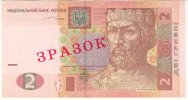
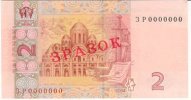
Ukraine: neue 2 Hryvna Banknote 2004
Die Ukraine setzt ihre neue Serie fort.
Nach dem 20er, dem 50er und dem 5er, komt nun die 2 Hryvna Note heraus.
Ausgabe war der 28. September 2004
The Banknote of 2 Hryvnias Denomination (2004)
The face side of the new banknote as well the face of the previous 2 hryvnia banknotes has the portrait of Yaroslav the Wise, and the back depicts the Cathedral of St. Sophia.
Yaroslav the Wise was a Grand Duke of Kyiv (1019-1054). In times of his ruling the “Russian Justice” Code of the Old Rus was composed and adopted, the Christianity was finally established in Rus and the culture developed. Yaroslav the Wise was buried in the Cathedral of St. Sophia in Kyiv.
The Cathedral of St. Sophia in Kyiv is a historical, architectural and wall painting monument of the first half of the XI century, which is famous worldwide. It was built in the golden age of Kyivan Rus to become the metropolitan`s cathedral, i.e. the principal church of Rus, on the place, where Yaroslav had won a victory over Pechenegs. Yaroslav founded therein the first library in Rus.
Security elements for visual detection
The banknote is printed on the tinted paper of brown color which is the dominating color of the design of the banknote.
Banknote size (63x118) mm.
1. Watermark
A multi-tone portrait, formed by the internal structure of paper, has a fixed position on the banknote and becomes visible when the banknote is held up to the light. Repeats the portrait printed on the face of the note.
1a. Light Watermark Element
Imprint of the numerical indication of the denomination is visible when looking at the banknote against the light.
2. Coded Security Thread
A fully embedded into the paper polymer coded thread with the following transparent direct and inversed images: “2 ГРН”, a trident and the underlined denomination “2”. The parts of the thread glowing in green-yellow and blue colors under the UV light.
3. Latent (Hidden) Image
A numerical indication of the denomination becomes visible when the banknote is tilted at a sharp angle to the light.
4. Relief Images
Graphic elements on the face of the banknote are printed in special printing when the ink is raised above the paper surface and can be felt by touch: a) the sign for the blind; b) the portrait; c) inscriptions; d) IZARD; e) numerical indication of the denomination.
5. See -Through Element
Printed elements on the face and on the back of the banknote which complement each other and form the letter “Y” when the note is held up to the light.
6. "Orloff" Printing
A special type of printing which forms a pattern with the ink of different colors ensuring an abrupt change of one color into another without intermittence and displacement of graphic elements of the pattern (lines, planes).
7. Microtext
Repeated inscriptions which can be read with magnifying glass.
8. Rainbow Printing
Special type of printing ensuring a smooth change of one color into another without intermittence and displacement of graphic elements of the pattern.
9. Serial Number
The serial numbers is printed in high printing:
1) with black inks having magnetic properties;
2) with red inks glowing under the UV light in yellow-red color.
10. Antiscanning Grid
Thin lines placed at different angles which form a moire pattern when copied or scanned.
11. Security Fibers
Chaotically embedded into the paper invisible security fibers glowing in red and green colors under the UV light.
Quelle: http://www.bank.gov.ua/Engl/Bank_coin/Banknoty/G2_04_discription_e.htm
Anhänge
- Registriert
- 07.01.2004
- Beiträge
- 3.029
- Reaktionspunkte
- 2
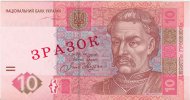
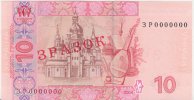
Ukraine Teil II: neuer 10 Hryvna Schein 2004
Nachdem erst kürzlich der neue 2er rauskam, wird es ab 1. november 2004
den neuen 10 Hryvna Schein geben.
The Banknote of 10 Hryvnias Denomination (2004)
As on the preceding banknotes of this denomination, on the face-value side of the new banknote there is a portrait of Ivan Mazepa, whereas on the reverse one, instead of the general view of Kyiv Pechersk Lavra, its Assumption Cathedral is depicted.
Ivan Mazepa was the Hetman of Ukraine (1687-1709), an eminent statesman of the Ukrainian nationhood. The main objective of the Hetman Mazepa’s policy was reunion of the Ukrainian lands in one and undivided Ukrainian state as well as constitution of strong Hetman’s authority.
Assumption Cathedral of the Kyiv Pechersk Lavra – the main temple of the Kyiv Pechersk Lavra (a group of hermitages), a historical and architectural monument of Rus-Ukraine of the 11-18 centuries, is of high artistic value and importance. It was restored at the end of 2000.
Security elements for visual detection
The banknote is printed on the tinted paper of crimson color which is the dominating color of the design of the banknote.
Banknote size (66x124) mm.
1. Watermark
A multi-tone portrait, formed by the internal structure of paper, has a fixed position on the banknote and becomes visible when the banknote is held up to the light. Repeats the portrait printed on the face of the note.
1a. Light Watermark Element
Imprint of the numerical indication of the denomination is visible when looking at the banknote against the light.
2. Coded Security Thread
A fully embedded into the paper polymer coded thread with the following transparent direct and inversed images: "10 ГРН", a trident and the underlined denomination "10". The parts of the thread glowing in green-yellow and blue colors under the UV light.
3. Latent (Hidden) Image
A numerical indication of the denomination becomes visible when the banknote is tilted at a sharp angle to the light.
4. Relief Images
Graphic elements on the face of the banknote are printed in special printing when the ink is raised above the paper surface and can be felt by touch: a) the sign for the blind; b) the portrait; c) inscriptions; d) IZARD; e) numerical indication of the denomination.
5. See -Through Element
Printed elements on the face and on the back of the banknote which complement each other and form the letter “Y” when the note is held up to the light.
6. "Orloff" Printing
A special type of printing which forms a pattern with the ink of different colors ensuring an abrupt change of one color into another without intermittence and displacement of graphic elements of the pattern (lines, planes).
7. Microtext
Repeated inscriptions which can be read with magnifying glass.
8. Rainbow Printing
Special type of printing ensuring a smooth change of one color into another without intermittence and displacement of graphic elements of the pattern.
9. Serial Numbers
The serial numbers is printed in high printing:
1) with black inks having magnetic properties;
2) with red inks glowing under the UV light in yellow-red color.
10. Antiscanning Grid
Thin lines placed at different angles which form a moire pattern when copied or scanned.
11. Security Fibers
Chaotically embedded into the paper invisible security fibers glowing in red and green colors under the UV light.
quelle: http://www.bank.gov.ua/Engl/Bank_coin/Banknoty/G10_04_discription_e.htm
Anhänge
- Registriert
- 07.01.2004
- Beiträge
- 3.029
- Reaktionspunkte
- 2
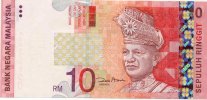
Malaysia: neue polys ab Dienstag
Polymer banknotes in circulation from Tuesday
BY YVONNE CHONG
Bank Negara will be introducing the nation's first polymer banknotes early next week.
The new polymer banknotes, which will go into circulation on Tuesday, will replace the existing paper banknotes, Bank Negara officials said yesterday.
The central bank is, however, keeping mum on the design as well as the denominations of the new banknotes.
Bank Negara had issued polymer banknotes with a face value of RM50 in 1998 but that was only to commemorate the Kuala Lumpur Commonwealth Games.
Once the central bank starts to issue polymer banknotes of a particular denomination, it will cease printing the paper version of that denomination. Existing paper banknotes in circulation will continue to be legal tender until they are returned to Bank Negara. Banknotes are usually returned to the central bank when they are soiled beyond circulation use.
The central bank has also declined to reveal where the polymer ringgit banknotes will be printed.
There are currently only a few printers globally that are capable of printing polymer banknotes and the majority of them are located in Australia, the first country to issue polymer banknotes. The first Australian polymer banknote was issued in 1988, after 20 years of research to developt echnology to print banknotes on plastic. By 1996, it had a complete series of circulating polymer banknotes.
Currently 23 countries, including Malaysia, have issued polymer banknotes, either for circulation or commemorative purposes. Three countries – Australia, New Zealand and Romania – have changed all their banknotes to polymer. Over 5.3 billion notes had been issued up to May 2004.
Polymer notes are robust, retain their quality and are cleaner and more hygienic to handle. They are tear-resistant, impervious to water and other liquids, do not absorb dirt and are resistant to germs due to the lack of moisture and nutrients on the notes.
It is also harder to counterfeit polymer banknotes. Security features incorporated in the note substrate and the note printing, such as the “clear window” on the note and “shadow image on the clear window”, are easily recognisable yet cannot be reproduced through colour photocopy or desktop publishing.
Quelle: http://biz.thestar.com.my/news/story.asp?file=/2004/10/22/business/9202095&sec=business


ich habe hier einen händler gefunden der immer so ziemlich die aktuellen noten im angebot hat !
hier geht es zum händler
vielleicht hilft es den einen oder anderen
hier geht es zum händler
vielleicht hilft es den einen oder anderen
- Registriert
- 07.01.2004
- Beiträge
- 3.029
- Reaktionspunkte
- 2
polymat schrieb:ich habe hier einen händler gefunden der immer so ziemlich die aktuellen noten im angebot hat !
hier geht es zum händler
vielleicht hilft es den einen oder anderen
Danke für den Tipp!!!

- Registriert
- 07.01.2004
- Beiträge
- 3.029
- Reaktionspunkte
- 2
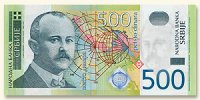
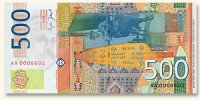
Serbien Montenegro neue Banknote zu 500 Dinar
500-dinar Banknote issued by the National Bank of Serbia
Year of introduction:
2004.
Main motifs on the obverse:
Portrait of Jovan Cvijic, geographer
Main motifs on the reverse:
Image of Jovan Cvijic, stylized ethno motives
Dimensions:
70 х 147 mm
Color:
Blue-green tones, with greenish and yellowish colors
In circulation from:
September 17, 2004
Quelle: http://www.nbs.yu/english/coins/index.htm
Anhänge

- Goldpreis
- 3.515,60 €/oz
113,04 €/g
- Silberpreis
- 43,23 €/oz
1,39 €/g
- Bitcoin
- 58033,40€
- Ethereum
- 1627,60€
Wichtige Links
Werbung:
- Goldmünzen
- Euro-Links
- Andorra
- Deutschland
- Belgien
- Bulgarien
- Estland
- Finnland
- Frankreich
- Griechenland
- Irland
- Italien
- Kroatien
- Lettland
- Litauen
- Luxemburg
- Malta
- Monaco
- Niederlande
- Österreich
- Portugal
- San Marino
- Slowakei
- Slowenien
- Spanien
- Vatikan
- Zypern enthaltene Affiliatelinks sind bezahlte Werbung von Ebay