Du verwendest einen veralteten Browser. Es ist möglich, dass diese oder andere Websites nicht korrekt angezeigt werden. Du solltest ein Upgrade durchführen oder einen alternativen Browser verwenden.
CALGARY -- The Bank of Canada launched another salvo in the war against counterfeiters yesterday with the release of a new $20 bill into circulation. The bill, first unveiled last month, has the same kind of security features as the new $100 banknote, and officials say the strategy appears to be working.
"We introduced it ($100 bill) March 17 and until now we've only seen 13 counterfeit bills that were successfully passed, and they're very poor quality," said Annie Degioanni, the Bank of Canada's senior analyst for the Prairies.
PHONEY MONEY
Canadian consumers and businesses lost $12.8 million last year due to phoney money. Unfortunately, the last person caught holding the bogus bills ends up taking the loss.
The new $20 banknote includes a holographic stripe covered with maple leaves and a watermark that only appears when you hold the note to the light.
Two other new features include a security thread, which is an anti-counterfeiting feature woven into the paper and a see-through number that makes it easy to spot a fake.
The new features are simple enough that businesses should be able to spot a phoney, said Const. Tej Cheema of the Calgary Police Service's business liaison program.
He said many businesses invest in counterfeit detectors but it's not really necessary.
"The human eye is still one of the best detective devices," Cheema said.
"If you invest in a $2 magnifying glass and look at the bill closely, it stands out clearly that you can tell a genuine from a copy."
There are some similarities to European banknotes and for good reason, said Degioanni.
"We work with other central banks throughout the world about increasing security features on all banknotes because counterfeiting is a global problem."
Die Meldung ist zwar nicht mehr aktuell, aber hier soll dennoch der 100K Schein aus Vietnam vorgestellt werden - MIT BILD.
Hier die Meldung:
New 100k notes: plastic fantastic
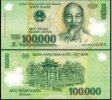
On September 1 the State Bank (SBV) will issue the new VND100,000 polymer banknote to protect against counterfeiting.
Send to a friend | Printable version
Aside from long standing security means, the new note will be protected from counterfeit by employing new tags, including the appearance of colourless, latent, luminescent and embossed images, which are easily for users to check while remaining almost impossible to counterfeit.
The new banknote is 144x65mm in size, and is green in colour. One face bears the Socialist Republic of Vietnam legend, along with the national insignia, a portrait of President Ho Chi Minh, its face value of VND100,000 both written and numerical, along with traditional and modern patterns.
The reverse face bears the words State Bank of Vietnam, and a landscape picture of Van Mieu (Temple of Literature) – Quoc Tu Giam, its face value of VND100,000 both written and numerical, and traditional and modern patterns.
According to the SBV, the issuance of the new polymer banknotes is a double edge sword, fighting against counterfeit money and protecting against wear and tear. Polymer banknotes last significantly longer than their paper predecessors.
The outgoing VND100,000 notes have been the most prone to forgery of Vietnam’s monetary denominations. While becoming obsolete, the old brown banknotes will still retain their value when the new breed is released into the wild.
SBV recommendations:
The new polymer banknotes have enhanced endurance and remain cleaner than the old paper banknotes. However, the notes are not heat-resistant, and may be deformed by exposure to high temperatures.
SBV recommends the notes be kept flat, not folded, crumpled or creased. Crumpled banknotes can be smoothed out by a light pressing. Do not iron the polymer notes, as they will melt.
General Information on Malaysian Banknotes (3rd Series): RM10 with LEAD
RM10 with LEAD | RM100 | RM50 | RM10 | RM5 | RM2 | RM50 Commemorative Polymer Banknote
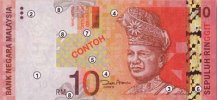
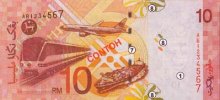
Bank Negara Malaysia is issuing an upgraded version of the RM10 denomination currency notes with an enhanced security feature. The upgraded RM10 currency note has an optical variable holographic strip on the obverse (similar to the strip used on RM50 and RM100 currency notes).
The introduction of the holographic strip is part of the Bank's continous efforts to improve the security features of the currency notes. The holographic strip makes the currency note more difficult to duplicate and yet easily detecable by the public.
Basically, the upgraded RM10 currency note retains the existing design, colour, security features and size. Except for the hologrphic strip, there is no significant change in the original design on the obverse and reverse of the upgraded RM10 currency note. They have been printed on the same material as in other circulating Malaysian currency notes.
The prominent security features of the RM10 currency note are highlighted in this brochure as a guide to the public. The public is advised to check carefully on the security features to ensure the authenticity of the note.
The upgraded RM10 currency note will co-circulate with the existing series. For more information on the upgraded RM10 currency note, please contact the Currency Management and Operation Department (Tel. ++ 60 3 2690 7309)
Südkorea: neue Banknotenserie inkl. 50K und 100K Won
Korea wird in kürze eine neu gestaltete Banknotenserie mit den bekannten Werten zu 1000, 5000 und 10K Won herausgeben.
ausserdem werden Banknoten zu 50,000 & 100,000 Won verausgabt werden.
Hier die Meldung:
Kim Ku to Be Featured in Banknote
By Choi Kyong-ae
Staff Reporter
The Korean Broadcasting System (KBS) reported Monday that the Bank of Korea (BOK) and the Korea Minting and Security Printing Corporation (KOMSCO) have nearly completed the preparations for the issuance of redenominated banknotes.
The two organizations have reportedly decided on the designs for a 100,000-won ($87) and 50,000-won bill. New designs for other small-denominated bills are also under consideration.
King Sejong, the fourth king of the Choson period (1392-1910) and one of the most respected kings in Korea, appears on the 10,000-won bill, which is currently the largest banknote available.
The 10,000-won bill underwent a facelift once in 1979, six years after the original design was adopted in 1973. Since then a couple of measures have been made to prevent counterfeit bills.
Kim Ku (1876-1949), who had dedicated himself to the nation’s liberation from Japanese colonial rule (1910-45), is likely to be pictured on the 100,000 won note and Chung Yak-yong (1762-1836), a famous scholar during the late Choson kingdom, would appear on the 50,000 won note, according to the report.
Shin Saimdang (1504-1551), a famous female artist in the middle of Choson period, is likely to be featured on the 5,000 won bill and Chang Young-sil, a famous scientist who invented a water watch which automatically signals time, is likely to be printed on the 1,000 won bill, it said.
However, officials of the BOK and KOMSCO called the report groundless, saying that no discussions have been made to determine the figures for the high-denominated bills.
“To issue new bills, the BOK should get approval from the government and an agreement from the Monetary Policy Board under its wing. We haven’t had any calls from the BOK to issue the bills,” a KOMSCO official on condition of anonymity said.
“Currently, the facilities to house the printing machine are under construction. But the additional machine has yet to come to Korea from Switzerland. The additional Swiss equipment is to reinforce the present printing line,’’ the official stressed.
He continued to say the established printing plant built in 1974 is in full operation all year around the clock. In its long-term facility investment plan, KOMSCO will import the Swiss machine by next August.
“It usually takes a couple of years for the state-run minting corporation to make all 3 billion new notes, including 1.3 billion coins, ready for a timely release. If new bills were adopted, the increased production line would be helpful,” another KOMSCO official said.
When installed sometime next year, the strengthened production lines in Kyongsan, North Kyongsang Province, will be ready to churn out up to 3 billion bills and coins valued at 24 trillion won.
Last month, Deputy Prime Minister and Finance-Economy Minister Lee Hun-jai said the government had no concrete plans for the new bills and BOK Governor Park Seung said the central bank was considering issuing the new bills in a long-term project.
The new series of Hong Kong banknotes go into circulation from October 11, in denominations of $20, $50 and $1,000.
They will be available for exchange in all branches of the three note-issuing banks - the Bank of China (HK), Standard Chartered Bank (HK) and HSBC.
The first two denominations of the new series, $100 and $500, have been in circulation since December. All existing banknotes will continue to be legal tender and will circulate alongside the new banknotes.
Leaflets explaining and illustrating security features of the new banknotes are being distributed and posters are on display at the three note-issuing banks and the Monetary Authority.
Information is also available on the websites of the Monetary Authority, Bank of China (HK), Standard Chartered Bank (HK) and HSBC.
To promote public awareness on the security features of the new banknotes, the authority has been conducting seminars, along with a student ambassador programme covering around 40,000 retailers in markets, shopping centres and neighbourhoods.